

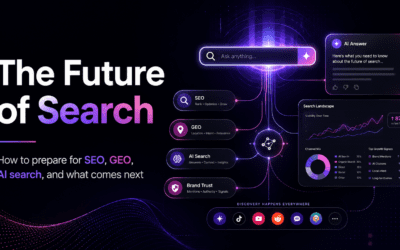
Search is no longer a list of ten blue links. Customers are asking complete questions, comparing options inside AI platforms, searching social media, checking maps and reviews, watching videos, and making decisions before they ever reach a company’s website.
This does not mean search is disappearing. It means search is expanding.
For businesses, the future of search is less about winning one ranking and more about creating a consistent, credible presence across the places where customers discover, research, compare, and choose.
Search is becoming a conversation
Traditional keyword searches are often short: “best CRM,” “roof repair Phoenix,” or “marketing agency near me.” AI-powered search encourages people to add context, ask follow-up questions, and refine what they want without beginning again.
A customer might ask for a recommendation, narrow it by price or location, request a comparison, and then ask what questions to bring to a consultation. Search becomes a continuing conversation rather than a series of disconnected queries.
This favors businesses that publish content with enough depth to answer the next question, not only the first one. A page that lists a service may earn attention. A page that explains who the service is for, how the process works, what affects cost, and how to evaluate options can support an entire decision.
Discovery is happening in more places
Google remains enormously important, but it is not the only place people search. Depending on the audience and decision, discovery may begin in an AI assistant, a social platform, a map listing, a video result, a marketplace, an online community, or a review site.
The strongest channel can change by question. A customer may use Instagram or TikTok for visual inspiration, Google Maps for proximity and reviews, YouTube for a demonstration, ChatGPT for an initial comparison, and a company’s website for proof and contact information.
This makes channel consistency more important. If each platform describes the business differently, customers receive a fragmented story. If the messaging, expertise, and essential facts reinforce one another, every touchpoint becomes more useful.
The click is no longer the only sign of visibility
Search platforms increasingly answer questions directly. An AI Overview may summarize a topic. A map result may display hours, reviews, photos, and directions. A social post may provide enough information to shape a preference without generating an immediate website session.
That creates a measurement challenge. Website traffic still matters, especially when the site is where conversions occur, but traffic alone cannot describe the full value of search visibility.
Businesses should also watch for changes in:
- Branded searches and direct traffic
- Qualified leads and assisted conversions
- Local actions such as calls, directions, and profile engagement
- Mentions, citations, reviews, and referral traffic
- Engagement with educational content across channels
- The quality of inquiries, not only the number of visits
A lower number of clicks is not automatically a lower level of influence. The more useful question is whether visibility is contributing to awareness, trust, and action.
SEO is evolving, not becoming obsolete
Predictions about the death of SEO have appeared throughout the history of search. AI is a substantial change, but the need to make information discoverable, understandable, and trustworthy remains.
Google states that established SEO practices continue to apply to AI Overviews and AI Mode. There is no special markup that guarantees inclusion. Pages still need sound technical foundations, helpful content, clear internal links, and information that satisfies the person behind the search.
The future of SEO will likely place even more emphasis on:
- Topical depth instead of isolated keyword pages
- Firsthand experience and original information
- Clear entities, relationships, services, people, and locations
- Strong brand signals and third-party validation
- Content designed around decisions and questions
- Technical accessibility across formats and devices
Keywords will still matter because words reveal intent. They simply will not be the entire strategy.
Search and advertising will work more closely together
Organic visibility can build long-term authority, while paid advertising can create immediate reach and place a business in front of carefully selected audiences. As organic search journeys become more complex, the relationship between the two becomes more valuable.
Search data can reveal questions worth answering through content. Paid campaigns can test messages, audiences, and offers more quickly. Retargeting can reconnect with people who researched without taking action. Strong educational pages can give advertising traffic a better place to land.
The future is not SEO versus advertising. It is a connected system in which content, search, advertising, social media, and analytics share information and support the same business goals.
What businesses should do next
Answer real customer questions
Listen to sales calls, emails, reviews, support requests, and search data. The best content opportunities often come directly from the questions customers repeat.
Build connected topic clusters
Create a useful primary page, then support it with articles that explain related decisions, challenges, comparisons, and trends. Link those resources together so visitors and search systems can understand the relationship.
Strengthen the brand behind the content
Show who created the information and why they are qualified to discuss it. Publish case studies, original observations, leadership perspectives, and details that could only come from real experience.
Keep local and business information accurate
Names, locations, services, hours, contact details, and company descriptions should remain consistent across the website and important third-party platforms.
Measure business outcomes
Rankings and traffic are useful indicators, not final objectives. Track calls, forms, qualified leads, revenue signals, and the actions that matter to the business.
The future belongs to brands that are easy to understand
Search will continue to change. Interfaces will evolve, AI platforms will add new capabilities, and measurement will improve. Businesses do not need to predict every feature to prepare effectively.
They need to communicate clearly, publish information worth finding, demonstrate why they are credible, and show up consistently wherever their customers search.
The future of search is not about tricking a new algorithm. It is about becoming a better and more complete answer.

0 Comments